
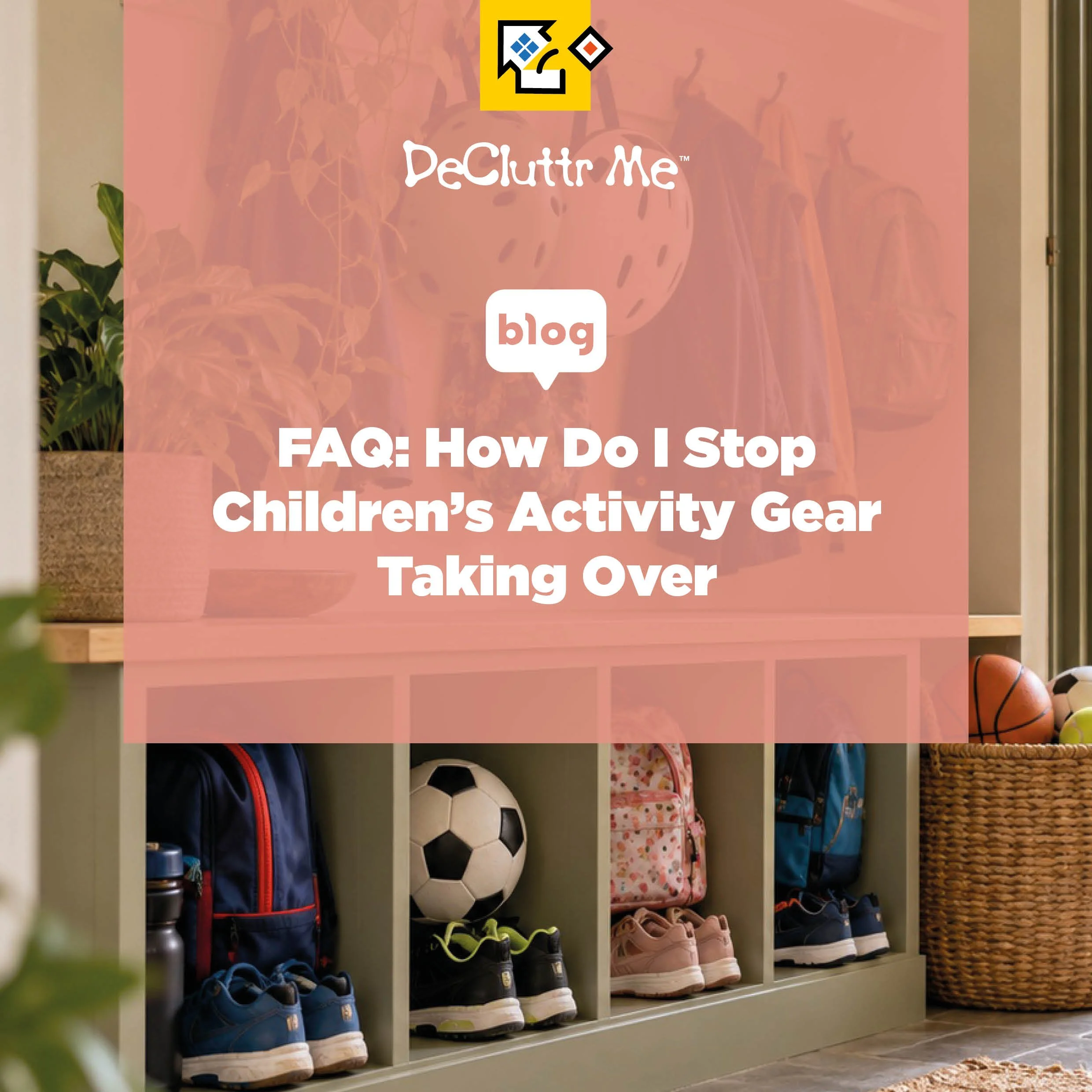
Football boots. Swimming bags. Dance shoes. Tennis rackets. Helmets. Shin pads. Backpacks. Balls. Water bottles. That scooter nobody has touched for six months.
Children's activity gear has a remarkable ability to multiply.
Part of the problem is that children don't simply acquire equipment. They move through it. They grow, change interests, try new activities and abandon others. Unless the things belonging to previous stages leave the home, the collection simply gets bigger.
So, how do you stop it taking over?
Do children really need separate storage for every activity?
Not necessarily.
If your child does several activities, creating a completely separate storage system for each one can become cumbersome. Instead, look at what needs to leave the house together.
A swimming bag can stay packed with swimming essentials. The football kit might live together in one accessible place. Equipment used less frequently can be stored elsewhere.
The system should make getting ready easier, not create more work.
What should I do with equipment they've outgrown?
Make the decision when you notice it.
Don't put the too-small football boots back with the current pair. Don't leave an outgrown helmet on the shelf because you'll decide what to do with it later.
Depending on its condition and suitability, you might pass an item on, donate it, sell it or dispose of it appropriately.
If you're genuinely keeping something for a younger sibling, move it out of the current activity area. Label it with the size and, if useful, the activity or child's name.
Current equipment and future hand-me-downs are two different categories. Treat them that way.
My child starts activities and then loses interest. What do I do with all the gear?
Give it a little time, but set a limit.
There's no need to remove everything the week after a child decides they no longer like an activity. Interests can change quickly.
But if a substantial amount of time has passed and there is no realistic intention of returning, ask why the equipment is still occupying accessible space.
Keeping the tennis racket doesn't preserve an interest in tennis.
How much activity gear should be accessible?
Only what is currently being used regularly needs prime position.
Think of your storage as having different levels of importance:
Regularly used: easy for the child to reach and return.
Occasionally used: available, but doesn't need the most convenient space.
Outgrown or inactive: make a decision about whether it needs to remain in the home.
This one distinction can free up a surprising amount of space.
How do I get children to put everything back?
Make it obvious and make it achievable.
A six-year-old's storage system shouldn't require adult height, perfect folding or complicated categorisation. Hooks, baskets, open sections and clearly defined spaces can be much more practical.
If a child repeatedly leaves the same item in the same place, pay attention. The designated storage may simply be too difficult or too far away.
Sometimes changing the system works better than repeating the instruction.
What about the collection of random balls?
Every family with active children seems to acquire one.
Give balls a defined boundary: a basket, rack or other suitable container. When the allocated space is full, review what's there before adding more.
The same principle works for many children's belongings. Instead of asking, “How many should we have?”, decide how much space you're prepared to give the category.
Is there a good time to review everything?
Yes. Use natural transition points.
The start or end of a sports season, school holidays, a change in weather or signing up for a new activity are all useful prompts.
Before buying equipment for the next activity, spend ten minutes checking what is already there.
You may find the missing water bottle.
You may also find three of them.