
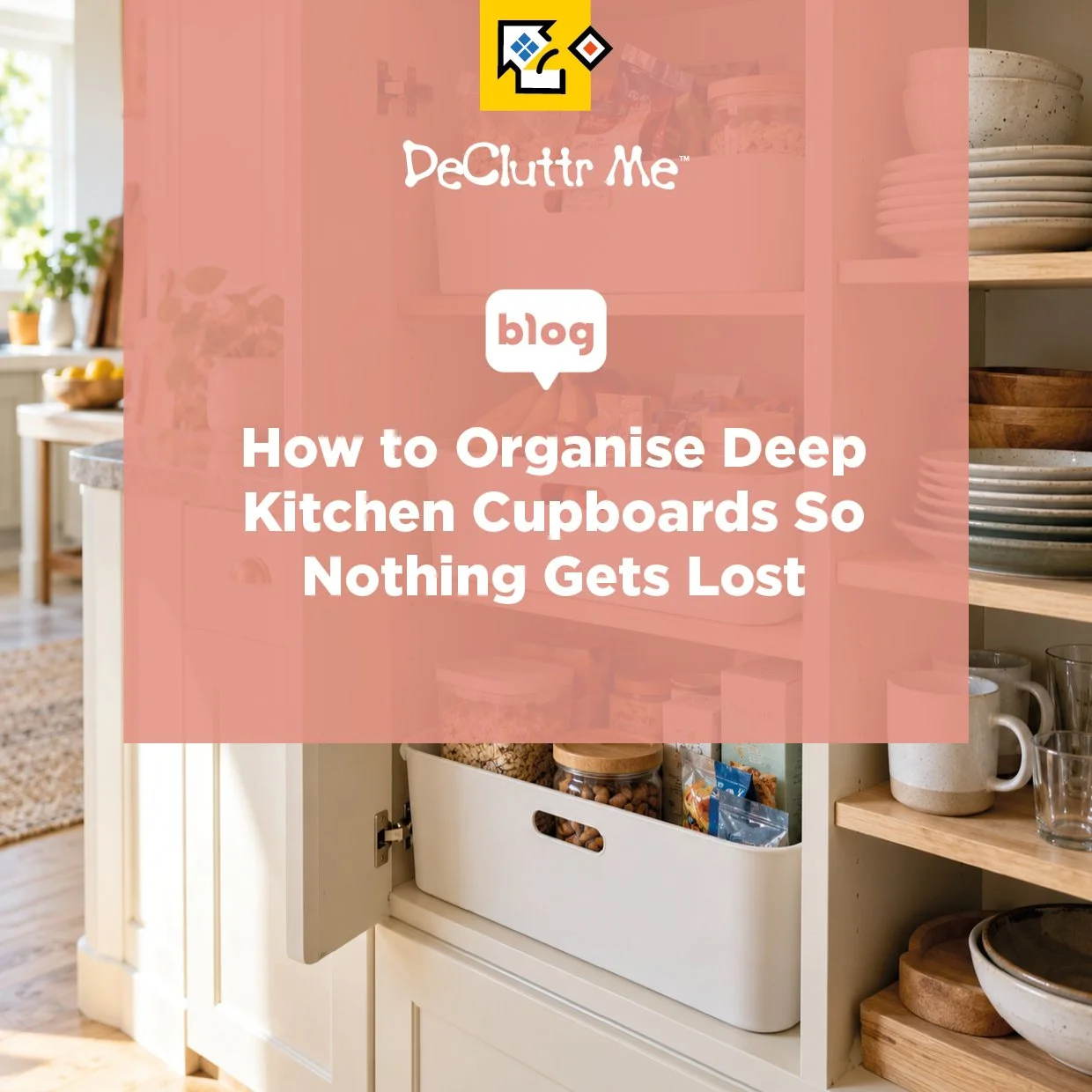
Deep kitchen cupboards seem like a wonderful storage feature until you actually start using them. There's plenty of room, but somehow the things you need always end up at the back, hidden behind everything else.
You buy another packet of pasta because you can't find the one you already have. The large mixing bowl disappears behind a collection of smaller ones. And retrieving a saucepan becomes an exercise in rearranging half the cupboard.
The problem isn't necessarily the amount of space. It's that deep cupboards allow things to disappear from view.
Fortunately, there are ways to make them considerably more practical.
First, Understand What's Going Wrong
Deep cupboards generally present three challenges:
Visibility: You can't easily see what's stored at the back.
Accessibility: Reaching one item often means moving several others.
Wasted space: Items are pushed towards the front while the space behind them remains underused, or everything gets piled together.
Before reorganising, identify which of these is causing the biggest frustration.
If you can't see what you own, you'll need a better way to group items. If you can't reach them, accessibility should be your priority.
Match the Storage Solution to the Problem
Not every deep cupboard needs the same approach. Consider these options depending on what you're storing.
Pull-out baskets for everyday items
Pull-out baskets are particularly useful for food packets, snacks and smaller ingredients.
Instead of reaching blindly towards the back, you can bring the contents forward and see everything at once.
Choose sturdy baskets that fit comfortably inside the cupboard, allowing enough clearance for the door hinges.
Turntables for bottles and jars
A rotating organiser can work well for sauces, condiments and smaller jars.
Rather than arranging everything in rows, you simply turn the organiser to reach items at the back.
They're especially useful in awkward corners, although they aren't always the best choice for rectangular cupboards where they may leave valuable space unused.
Large containers for grouped items
Deep cupboards can accommodate larger baskets or containers that hold related items together.
For example, you might create separate groups for baking ingredients, breakfast foods or occasional entertaining essentials.
The advantage is that you can remove the entire container rather than searching through individual items.
Vertical dividers for trays and boards
Baking trays, chopping boards and serving platters can be difficult to access when stacked horizontally.
Storing them upright with dividers allows you to remove one without disturbing everything else.
This works particularly well in deep lower cupboards.
What Belongs at the Back?
The back of a cupboard isn't necessarily wasted space. It can be useful for items you don't need regularly.
Think about the things you use only occasionally:
Large serving platters for entertaining.
Seasonal baking equipment.
Spare crockery.
Specialist appliances.
Extra food containers that are genuinely needed.
Keep everyday essentials towards the front, where you can reach them without rearranging anything.
One important exception is heavy equipment. Large appliances and heavy cookware should be stored at a comfortable, safe lifting height rather than pushed into awkward positions.
Avoid the Temptation to Stack Everything
When a cupboard is deep and tall, it's tempting to build increasingly high stacks.
But just because something fits doesn't mean it's practical.
If you need to remove six plates to reach a bowl, or lift several saucepans to retrieve the one underneath, your storage arrangement is creating unnecessary work.
Shelf risers can help separate smaller stacks, while pan organisers may make individual pieces easier to access.
Remember to leave enough room to lift items out comfortably.
The Cupboard Accessibility Check
Once you've reorganised, try a simple test.
Open the cupboard and choose three items you use regularly.
Can you see each one? Can you reach it without moving several other things? Can you put it back just as easily?
If the answer is yes, your arrangement is working.
If not, reconsider the position or storage method rather than trying to squeeze everything into place.
A well-organised deep cupboard shouldn't require you to remember what's hidden behind everything else. You should be able to open the door, find what you need and get on with your day.